Morgan Günther · 6 October 2026
Valewood High Integrates Local Ecology into History Classes to Highlight Valley Land Use Patterns
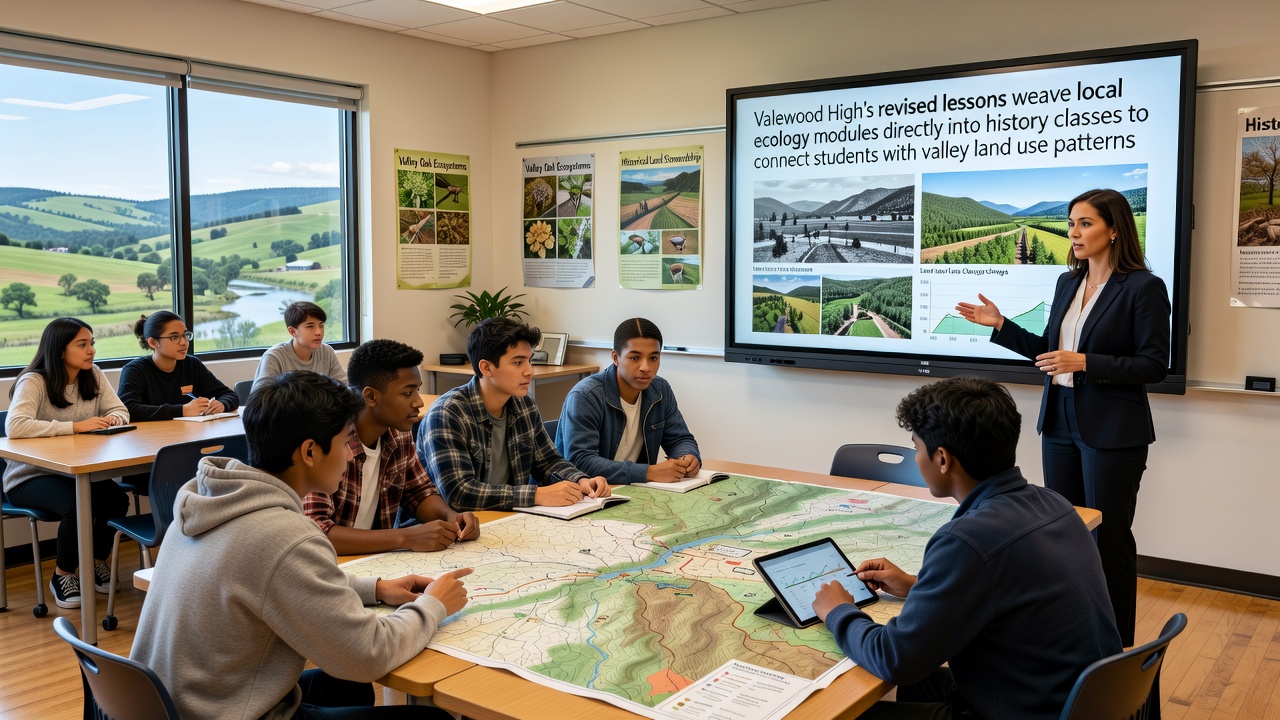
Valewood High has updated its curriculum so that ecology modules now appear inside history classes, and this change lets students examine how past land use decisions still shape the valley's ecosystems today. Teachers combine timelines of settlement and agriculture with data on soil health, water flow, and native species distribution, while the result is a single lesson sequence that runs from pre-colonial practices through modern development. The district rolled out the first full units in October 2026 after a two-year planning period that involved local historians, ecologists, and curriculum specialists.
Structure of the Revised Lessons
Each history unit now opens with a short ecology segment that presents current field measurements from valley sites, and students then trace those same sites backward through archival records and oral histories. One module covers 19th-century logging roads that still influence drainage patterns, while another follows 20th-century irrigation canals and their effect on riparian vegetation. Lessons use the same set of GIS layers for both historical maps and present-day satellite imagery, so comparisons stay concrete rather than abstract.
Connection to Local Land Use Data
School staff worked with county planning offices to obtain land-cover datasets that span eight decades, and those datasets now sit inside the classroom portal alongside digitized property records. Students calculate changes in forest cover and wetland area by decade, then match those numbers to policy shifts documented in town meeting minutes. Figures from the U.S. Geological Survey indicate that valley farmland expanded by 18 percent between 1940 and 1980, yet regrowth of secondary forest since 1990 has altered runoff rates in several sub-watersheds. The curriculum places these statistics next to primary sources so learners can test whether recorded decisions align with measured ecological outcomes.
Implementation Timeline and October 2026 Rollout
Planning began in 2024 when the history department requested ecology support, and a joint committee finished the module outlines by spring 2026. Full classroom use started in October 2026 with ninth-grade world history sections, while tenth-grade U.S. history classes followed in the next term. Professional development sessions for teachers ran on early-release Wednesdays throughout September, and each session included a field walk led by a county natural-resource technician.
Student Activities and Assessment
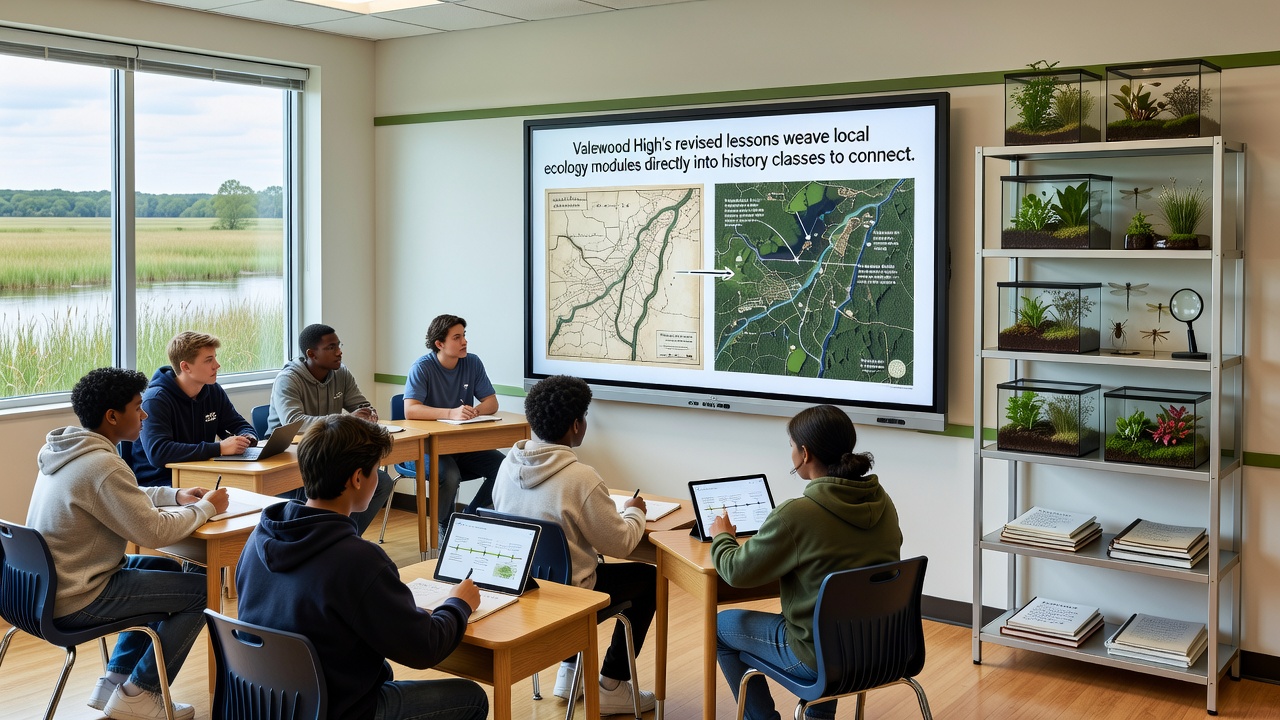
Assignments require learners to produce layered maps that overlay 1950s aerial photos with 2025 drone imagery, and they must write short explanations of any visible vegetation shifts. One task asks groups to interview long-term residents about changes in hunting or farming practices, then compare those accounts with vegetation transects collected by the class. Rubrics award points for accurate use of both historical evidence and ecological measurements, while group presentations occur at the end of each six-week unit.
Partnerships and External Resources
The high school maintains an ongoing agreement with the county conservation district that supplies guest speakers and equipment loans, and similar arrangements exist with the regional office of the Bureau of Land Management. A separate collaboration with the Australian Association for Environmental Education provides sample interdisciplinary units that staff adapted for valley conditions. These partnerships supply updated datasets each semester without requiring the school to maintain its own monitoring stations.
Broader Context of Interdisciplinary Education
School districts across several western states have tested similar history-ecology pairings since 2020, and preliminary reports show increased student retention of both subject matter and spatial-analysis skills. At Valewood High the approach also satisfies state requirements for environmental literacy that took effect in 2025. Observers note that the valley setting supplies a ready-made case study because land-use records remain relatively complete and accessible.
Conclusion
Valewood High's revised lessons demonstrate one concrete method for linking two traditionally separate subjects while keeping the focus on measurable local conditions. The October 2026 implementation marks the point at which the integrated modules moved from planning documents into daily classroom use, and ongoing data collection will show whether the approach produces lasting changes in how students interpret the valley landscape.